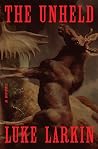
 The Unheld: A Novel by Luke Larkin
My rating: 4 of 5 stars
I was provided a ARC of this book via Netgalley, all opinions are my own.
This was so good. It combines all of the eerie and spooky elements I love about horror but with a western twist. The horror elements mirror real life in many ways, but it was done in such a fantastic way. I will certainly never look at hands quite the same way again.
This follows 12 year old Charlie, daughter of the local hunter, whose mother passed at her birth. She's been raised rough and doesn't talk much. Lately her father's catches have become stranger and stranger and no one wants to purchase them until a strange man comes to town. Mr. Elias deals in strange things and is opening a curio shop in town full of strange and wonderful things. He just so happens to understand why the animals in the forest are changing and has a vested interest in stopping it. He and Charlie become acquainted and he quickly finds that he wants to help her, especially when her father is taken by a strange beast that is at the center of all of the strangeness that is happening. Charlie and Mr. Elias encounter Patton who is also after the beast and whether or not they like it, the 3 of them team up to save Charlie's father and save the town. There is so much more to the story but to say more would spoil it.
I loved the portrayal of Charlie and her father's relationship, and how the horror elements and the way the forest and bleak atmosphere that was portrayed really brought to life the emotions Charlie was feeling and how that played out in the story. There were times that things that happened with the beast didn't make sense but they all came together in the end. I also enjoyed the development of Mr. Elias and Charlie's relationship. She was never afraid to tell him what she wanted or needed because she had been fending for herself for so long. I also appreciated the addition of Patton's character and the voice he gave to the land and the history he brought to the story. I really loved this from the first chapter!
Content warnings: Body horror, Child neglect, Animal attack, Animal death, Death of a parent
View all my reviews
Q&A withe the Author
provided by We Are Bookish
You’ve talked about how influential Montana is to you as a writer. How
did that shape the way you wrote the setting of The Unheld?
In my view, the book is entirely of Montana, but not all of Montana is in the
book, and I hope readers appreciate that. This place I call my home is multi
hyphenate, multitudinous. As a horror writer, I drew on the sparser landscapes
of the state—the vast plains, the burnt-out forests, the looming stone faces of
the mountains. It’s easy to feel small in a place like this. Sometimes, that
feeling is a pleasure, as when you’re out in the backcountry on a glittering day.
Other times, that feeling is acute, consuming, and inescapable, like there’s
nowhere to hide and something is looking for you. I tried to tap into the latter
for this novel.
Even more than setting, though, is history. The period the novel is set in,
sometime in the 1890s, was not a glamorous or kind one for the region or the
people within it. It was a time of unthinkable settler and colonial violence and
exploitation of Native tribes and others. I think and hope that this book
speaks to that, as well, because it’s as much part of this place’s identity as the
beauty is. It’s a fraught country. The whole place is. I wish it weren’t.
What drew you to the theme of loneliness and the desire to explore it
through the genre of horror?
Loneliness is foundational to horror, I think. Maybe loneliness is horror. I’m
hard-pressed to think of a horror story where the main character isn’t lonely or
made to feel alone in some way, I think, because that’s the root of terror and
fear, that suspicion or knowing that you’re alone. For a character in horror,
even when there are others with you, there comes a point in every horror story
where it’s just you, and you realize that you have to look out for yourself, and
that’s what I think is the scary part. We are the characters, the “you,” and we
watch our fear play out for us: that maybe nobody’s coming to save us. It’s just
you against the dark, and if you can’t depend on yourself, it’s over.
5
I think that speaks to a very American viewpoint, maybe—that
individuality—and part of what I love about horror is how it
challenges that individuality at every turn. Like, okay, Mr. Rugged
Individual, see how you like it! Face it all alone, why don’t you! And
so, much of this novel and what I wanted to write about, on top of
the terror that comes with being alone and the desperation and
uncanniness it brings, is the widespread fear of the opposite, of
understanding and acceptance. The chasm between each of us.
It’s gaping, but we have to cross it. We have to.
There are multiple points of view throughout the novel: Charlie,
Theodore, Patton, and even a chapter from the Beast. Which was the
most challenging character to write, and which was the most enjoyable?
That’s tough! Charlie is the beating heart. She’s where it started, and she
embodies that sense of helplessness, that smallness I mentioned. Hers is a
journey of finding her own help in her own hands, and that was a pleasure to
discover alongside her.
Theodore is the brain, then. He’s an intellectual, and sometimes that’s not a
good thing for him. He’s the stranger in a strange land, misguided and
secretive. A character who is not of the land but seeks to comprehend and
overcome it, which is a fool’s game, as he finds out. He was challenging in
that way, as a character you want to knock some sense into, in no small part
because you feel for him. I do, at least.
And Patton, or Paveameohtse, is maybe the soul, the essence. His presence in
the story is, I felt, as necessary as the land’s. Other characters probably have
less to lose than Patton has already lost, and that was important to me to
communicate without reducing him to that loss. He has more than any to gain,
too, I think. He was trickiest, but not at all frustrating. Nutritive.
The Beast’s chapter was a surprise, and was the final puzzle piece, in a sense.
I discovered that, if I’m to write a book about a monster that preys on
loneliness, and if the monster’s “weakness” is understanding and connection,
then we have to get inside the monster’s head, don’t we, if we ever want to put
this thing to bed, if it’s ever to be defeated.
We’re in a horror renaissance right now. What do you think pulls readers
to these stories? What pulls you to writing them?
I spoke a little about it already when I talked of loneliness just now, but the
answer is catharsis, totally. It’s a lot like tragedy, that way. You often hear
about Mary Shelley being the mother of horror, and if that’s true,
then Shakespeare is its patron saint. For me, horror is about seeing
our fears rendered and played out to their natural conclusions in a
safe, controlled environment, just like a tragedy on stage. Horror,
even at its most “base,” is always political that way, and that’s why
it’s always interesting. There’s always something to be afraid of, that
we’re trying frantically to wrap our minds around and to solve.
Instead of diminishing our fears, we can dress them up and make
them both more powerful and totally defanged, and that helps a lot
in understanding them.
The Beast stalking and haunting the characters in The Unheld is unique
and unsettling. Did you know early on that hands would play such a vital
role for both the Beast and the story?
I think about hands a lot! For most of us, they’re the primary physical way we
encounter the world, aren’t they? It’s a terrifying business, to touch and be
touched, understand and be understood. The characters in this book are touch
averse, all in their own ways, and often literally, but definitely metaphorically
and emotionally, too. To have each of them hounded, haunted, taunted, and
confronted by literal hands, both foreign and familiar, felt natural and freaky,
and was quite a launching point for the ideas here.
Horror readers know that survival is never guaranteed. Were there any
characters who you originally planned on dying but made it out alive, or
vice versa? If so, what changed their fate?
Honestly, not really, and sometimes I feel that that makes me some sort of
traitor in the horror genre. Like, I saved every main character! No final girl this
time, sorry. Maybe I’m a coward that way, but more important to me was
offering each of them the chance to overcome, and, well, they all took it. If my
aim here was to craft a vision of how connection, understanding, and even
intimacy offer salvation against loneliness, then who am I to deny that
salvation to any one character? Who am I to say that some people can be
saved by it and others are forsaken? More productive, maybe, to show how
each of them finds that salvation and what it means to them.
That’s why Charlie’s father had to die, though. He is saved, I think—redeemed?
—but not physically. That was another vector of that kind of salvation I wanted
to tinker with. If Charlie can’t physically save her father, what then? How does
she make sense of her own isolation and hurt without retribution? If the man
who inflicted loneliness upon her all her life finally leaves her, ultimately and
irreversibly? What if, perish the thought, he’s sorry, has no good excuse for
himself, and all she’s left with is the choice to forgive him? Should she? Must
she? Is that salvation?
Moving forward, though, I won’t be so sparing of my characters, I
don’t think. This was a special case, to start.
Luke's Playlist
Spotify link
“I Can See the Devil”
by S.G. Goodman
“This Is a Photograph”
by Kevin Morby
“Another Wasted Life”
by Rhiannon Giddens
“Lost River”
by Murder by Death
“Morton’s Fork”
by Typhoon
“Carnage”
by the Antlers
“Hunter”
by Björk
“Buffalo Replaced”
by Mitski
“Feel It All”
by KT Tunstall
“Let Me Drown”
by Orville Peck
“You don’t even know who I am”
by underscores
“Far Away”
by Kelela
“Nettles”
by Ethel Cain
“Sadness As a Gift”
by Adrianne Lenker
“Sad and Beautiful World”
by Mavis Staples
“Post Script”
by Typhoon
“Haunt Me”
by Sade
12

No comments:
Post a Comment